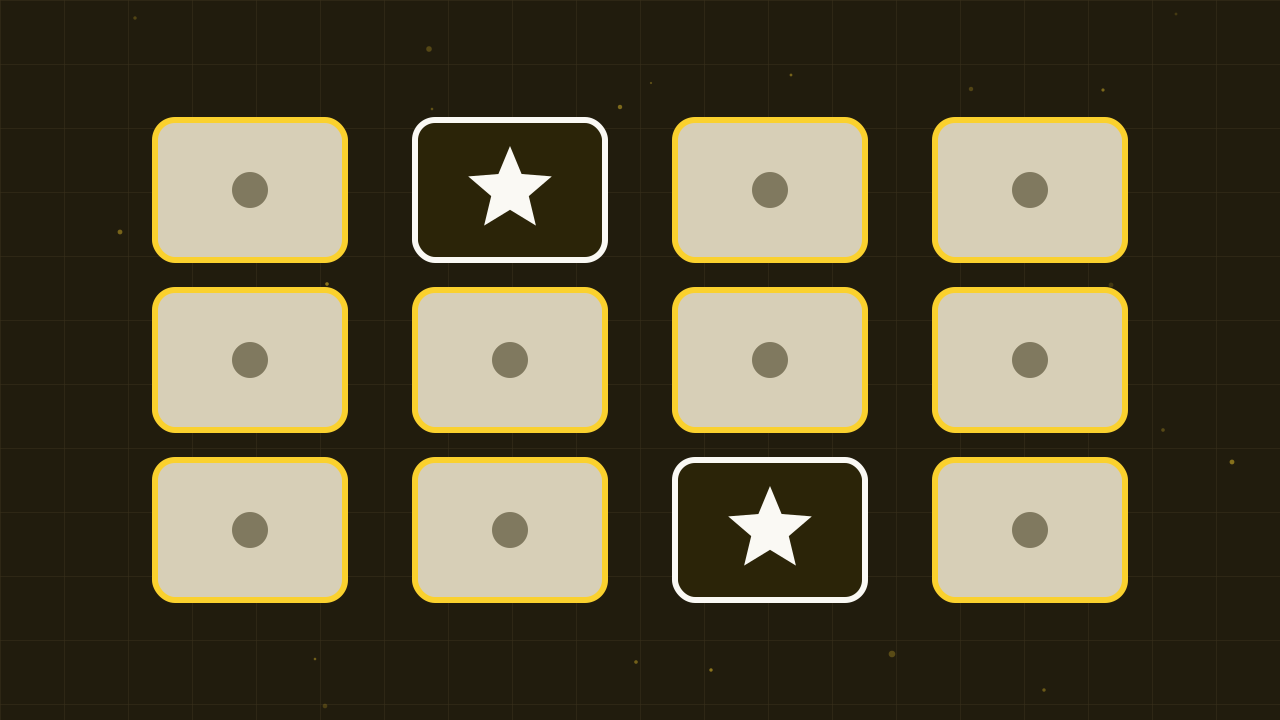
Memory matching games are among the oldest and most familiar games there are. A grid of cards lies face down, you turn over two at a time and try to find matching pairs. When the pictures match, the pair stays revealed. When they do not, the cards flip back and you have to remember where they were. It is simple enough for young children and still challenging for adults when the grid gets large. This guide shares easy techniques that help you remember more and clear the board faster.
How memory matching works
Every memory game follows the same basic rules. All cards begin face down. On each turn you reveal two cards. If they match, you keep them and often take another turn. If they do not, both cards are hidden again. The game ends when every pair has been found. Some versions count how many turns you take, others use a timer and multiplayer versions award points for each pair a player collects.
The first turns are for gathering information
At the start of a game, you know nothing about the board, so your first few turns are mainly about discovery. Rather than flipping cards at random, think of each turn as collecting information. Every card you reveal is a clue you can use later. Even a turn that finds no match is valuable if you remember what you saw.
Flip in a systematic order
Random flipping makes cards much harder to remember. A better approach is to work through the grid in a consistent order, such as row by row from the top left. This builds a mental map where each card has a clear position. When you later need a card you saw, you can recall it as being in a particular row and column rather than somewhere on the board.
Start with corners and edges
Corners and edges are easier to remember than cards in the middle of a grid, because they have fewer neighbours and clear reference points. Many players find it helpful to reveal edge cards first and save the crowded middle for later, when fewer cards remain and positions are easier to track.
Name what you see
One of the most effective memory tricks is to say the name of each card in your head, or quietly out loud, along with its position. For example: top left, snowman. Second row, end, candle. Putting words to images uses more of your memory than just looking, and the names are easier to recall later. Some players even turn the names into a little story or rhyme.
Use the first card wisely
When you reveal the first card of a turn, pause and ask whether you have seen its partner before. If you have, go straight to that position. If you have not, use the second flip to reveal a new, unknown card rather than one you already know. This way, every turn adds new information instead of wasting a flip on something familiar.
Group positions together
For larger boards, divide the grid into sections, such as four quarters. Remembering that a card is in the top right quarter narrows down the search considerably. Within each section, you only need to remember a few positions, which is much easier than tracking an entire board.
Do not panic after a miss
Mismatches are part of the game, and they are not wasted. Each miss teaches you two positions. Instead of feeling frustrated, focus on locking in what you just learned. Players who stay calm after a miss tend to remember more than those who rush their next turn.
Playing with others
Multiplayer memory games add an extra layer. When other players take their turns, watch closely. Every card they reveal is information you can use too. In fact, careful observation of other players' turns is one of the best ways to win. When it is your turn, try to make matches using cards revealed by others before you start exploring new ones.
Memory games are a wonderful choice for family play because players of all ages can compete on fairly equal terms. Children are often surprisingly good at them. For more ways to enjoy games as a household, see our guide to browser games for families.
Themed memory games
Memory games come in many themes, from holidays and animals to food and fantasy. Themed pictures can make cards easier to remember because they carry meaning. A cozy holiday set with distinct symbols like candles, cookies and snowmen is often easier than a set of abstract shapes. If you are learning, start with a theme where the pictures are clearly different from each other.
Why memory games are good fun
Memory matching combines a little luck with a lot of focus. Each successful match feels rewarding, and clearing a large board without many mistakes is genuinely satisfying. They also make a calm, gentle activity, which is why many people enjoy them as a way to unwind. You can find more ideas for calm play in our guide to relaxing games for stress relief.
Quick summary
- Treat early turns as information gathering.
- Flip cards in a consistent order.
- Start with corners and edges.
- Name each card and its position.
- Use your second flip to reveal something new.
- Watch other players' turns closely.
Test your memory
Ready to put these tricks into practice? Find memory and matching games in the Puzzle and Logic and Multiplayer categories, and see how quickly you can clear the board.